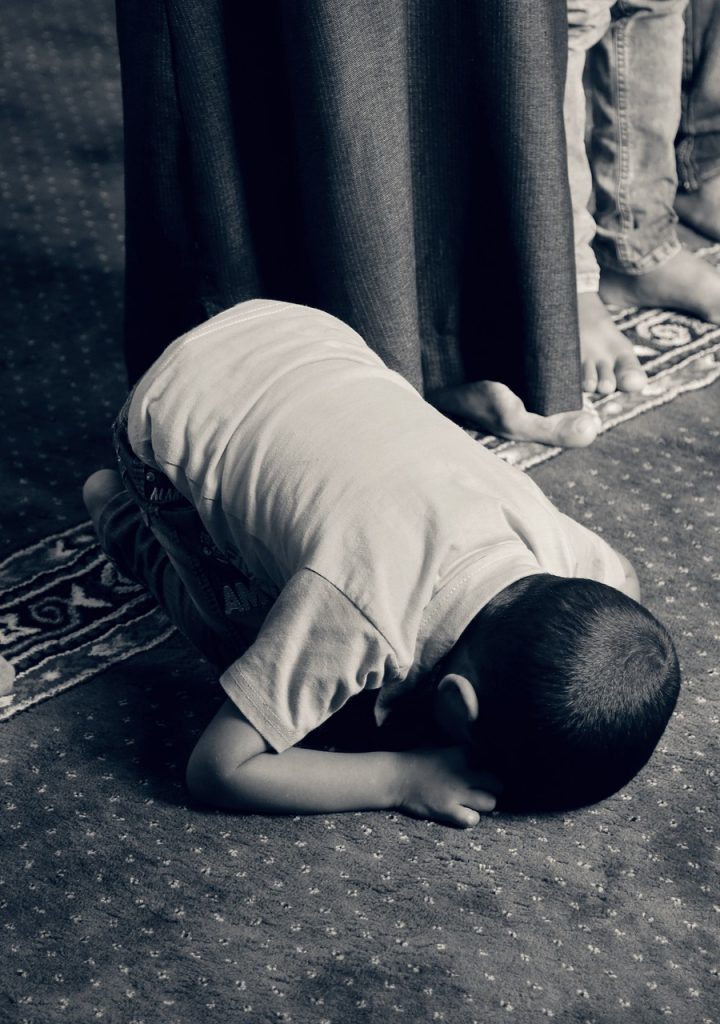
Submit and obey.

phpe73upogreyam.jpgal-Salāmu ‘alaykum wa rahmatullāh,

Sometimes there appear mushtarak lafdhee words in the Qur’an, that sound and are written the same as one another, but appear to be somewhat different in meaning, and it is sometimes difficult to make a link between the various meanings or draw them back to an original meaning. An example of this the word دينdeen‘ in the following verses:


مَا كَانَ لِيَأْخُذَ أَخَاهُ فِي دِينِ الْمَلِكِ إِلاَّ أَن يَشَاءَ اللّهُ

He could not take his brother by the law of the king (as a slave), except that Allah willed it. [12:76]


مَالِكِ يَوْمِالدين

Sovereign of the Day of Judgment [1:4]

The word ‘deen‘ comes from the root daal-yaa’-noon د – ي – ن, and the basic meaning of the word is submissiveness and obedience.

Thus, the word ‘deen دين in its most well-known meaning of ‘creed’ is so called because one submits to the tenets of the creed and obeys them. Continue reading

Don’t be a hater.

peace-dove.gifal-Salāmu ‘alaykum wa rahmatullāh,

When Ibn ‘Aashoor (d. 1973/1393) wrote his tafseer on the Qur’an, which he called Tafsir al-Tahrir wa al-Tanwir, he followed a number of basic principles in his methodology, particularly when it came to the linguistic exegesis, with which his tafseer is replete. These principles are generally based on the semantic connotations of individual words, and how these meanings relate to the context in which they are found.

This linguistic analysis is perhaps the most outstanding feature of this tafseer, and this is due to the high regard in which Ibn ‘Ashoor regarded such analysis. He himself commented in the begining of this work,


“With regards the Arabic language, then the purpose of it is to understand the intents of the Arabs in the speech and literature of their language…the Qur’an is in Arabic, and thus the rules of Arabic [grammar] are a means by which to understand the meanings of the Qur’an. Without [knowledge of] these rules, the reader will fall into error and incorrect understanding…”

This tafseer is truly distinguished from other tafseers by Ibn ‘Ashoor’s precise linguistic analysis, in the way he shows the meaning of the Qur’anic words and their semantic connotations, and the way in which they are used in their context. Continue reading

The story’s secret.

open-book.gifal-Salāmu ‘alaykum wa rahmatullāh,

To look back to the original meaning of a word is to embark on more than just a linguistic voyage; in some cases, tracing a word back to its original meaning is actually the key to unlocking one of the treasures of the guidance of the Qur’an.

For example, Allaah said in the introduction to the story of Prophet Yusuf (peace be upon him),

نَحْنُ نَقُصُّ عَلَيْكَ أَحْسَنَ الْقَصَصِ بِمَا أَوْحَيْنَا إِلَيْكَ هَـذَا الْقُرْآنَ وَإِن كُنتَ مِن قَبْلِهِ لَمِنَ الْغَافِلِينَ

We relate to you, the best of stories (qasas) in what We have revealed to you of this Qur’an although you were, before it, among the unaware.

wherein the real secret behind Allah relating this story to us lies in none other than the word story itself. Continue reading

Dealing with extremities.

hurricanenature_140×140.jpgal-Salāmu ‘alaykum wa rahmatullāh,

There are certain noun forms in Arabic known as siyagh al-mubaalaghah (‘forms of intensification/hyperbolic forms’) that are used to put across a more intense meaning than the original noun form. For example, a liar ‘kaadhib كاذب may also be known as a kadhoob كذوب or a kadhdhaab كذّاب - all carrying the meaning of ‘liar’ but denoting different levels of intensity.

Allaah often uses these forms in the Qur’an, and thus we find that He refers to Himself as al-Ghaffaar الغفار (Ta-Ha verse 82) and al-Ghafoor الغفور (al-Burooj, verse 14).

Similarly, the slanderer has been referred to as a hammaaz هماز (al-Qalam, verse 11), and a humazah همزة (al-Humazah, verse 1).

Is there a difference between these forms of essentially the same word? Abu Hilal al-’Askari, author of al-Furooq al-Lughawiyyah, said that it is impossible for there to be two different words in Arabic that have exactly the same meaning, and that those who are unaware of the differences think that the different words are only different hyperbolic forms, whereas they also reflect different meanings. Continue reading

Eternal regret.

regret-chains.jpgal-Salāmu ‘alaykum wa rahmatullāh,

There are some commentaries on the Qur’an (tafseers) which have a strong linguistic element, and within such commentaries one may sometimes find that the different types of ishtiqaaq have been used to offer a depth of meaning and insight that would not ordinarily be understood had reference to the ishtiqaaq not been made.

One such example of this can be found in the tafseer of al-Qurtubi in which he commented on the regret expressed in verse 54 of Surah Yunus,

وَلَوْ أَنَّ لِكُلِّ نَفْسٍ ظَلَمَتْ مَا فِي الأَرْضِ لاَفْتَدَتْ بِهِ وَأَسَرُّواْ النَّدَامَةَ لَمَّا رَأَوُاْ الْعَذَابَ وَقُضِيَ بَيْنَهُم بِالْقِسْطِ وَهُمْ لاَ يُظْلَمُونَ

And if every self that has done injustice had whatever is in the earth, it would indeed ransom itself therewith; and they will keep secret [their] regret (al-nadaamah) as soon as they see the torment, and [the case] is decreed between them with equity, and they are not done an injustice.

al-Qurtubi commented that the word used for regret – al-nadaamah – comes from the root noon-daal-meem ن-د-م. He then mentioned that these letters rearranged form the root daal-meem-noon د-م-ن, which means to continue and persist in something.

Such knowledge undoubtedly deepens our appreciation of the type of regret that such a person as is mentioned in the verse will feel – a regret that is continual and everlasting, and from the chains of which they will never break free.

May Allah protect us from being one of these people. Ameen.

Best seen in context.

seencontext.jpgal-Salāmu ‘alaykum wa rahmatullāh,

Many people who have set about to memorise the Qur’an, or portions of the Qur’an, will at some point have become confused when they come to a verse they have learnt elsewhere in the Qur’an, but with a slight change in wording or order. The key to overcoming this confusion, more often than not, lies in understanding two things: 1) the meaning of the words, 2) the context. So important is context that some linguists say that words only come to have a meaning once they are put in a context, otherwise what is to say that the meaning of ‘ayn عين is ‘eye’ and not ‘spring’?

To give an example, Allah says in Surah al-Baqarah, verse 86,

أُولَـئِكَ الَّذِينَ اشْتَرَوُاْ الْحَيَاةَ الدُّنْيَا بِالآَخِرَةِ فَلاَ يُخَفَّفُ عَنْهُمُ الْعَذَابُ وَلاَ هُمْ يُنصَرُونَ
Those are the ones who have bought the life of this world [in exchange] for the Hereafter, so the punishment will not be lightened for them, nor will they be aided. (yunsaroon).

He later says in the same chapter (verse 162),

خَالِدِينَ فِيهَا لاَ يُخَفَّفُ عَنْهُمُ الْعَذَابُ وَلاَ هُمْ يُنظَرُونَ
Abiding eternally therein. The punishment will not be lightened for them, nor will they be reprieved. (yundharoon).

Just as He says in Surah Aal-‘Imraan, verse 88,

خَالِدِينَ فِيهَا لاَ يُخَفَّفُ عَنْهُمُ الْعَذَابُ وَلاَ هُمْ يُنظَرُونَ
Abiding eternally therein. The punishment will not be lightened for them, nor will they be reprieved. (yundharoon).

Thus He has used the word ‘yunsaroon’ in one context, but ‘yundharoon’ in two others. Continue reading

It just doesn’t sound right.

ear.jpgal-Salāmu ‘alaykum wa rahmatullāh,

The sound and pronunciation of a word is very important in Arabic, and this especially becomes a problem in the case of generating new words via the naht process. (Although it was mentioned before that one cannot do naht at their whim, the council of Arabic Language has permitted cases of naht to be submitted to them for review for the sake of meeting with the demands of modern terminology into the language).

Some of these problems are that when you combine two or more words in naht, some of the letters invariably have to be dropped. But which letters are dropped and which are retained is a crucial issue, for there are a number of linguistic ‘flaws’ related to words, some of which are that two letters following each other may be considered heavy on the tongue (al-thiqal), or adjacent letters may be discordant or inharmonious with one another. Thus, Ibrahim Anees offered some guidelines (published in Mujallat Majma’ al-Lughah al-’Arabiyyah fee al-Qahirah, ed. 30) followed by classical scholars in the words they welcomed into the language, to help us judge whether new words are harmonious and acceptable to Arabic or not. Some of these are: Continue reading

The correct combination.

padlock.jpgal-Salāmu ‘alaykum wa rahmatullāh,

I came across an amusing anecdote in Lisan al-’Arab recently illustrating the dangers of engaging in naht haphazardly.

It is related from Ibn Mas’ood (may Allah be pleased with him) that his wife one day asked him to provide a jilbab (protective outer garment worn outside the house) for her. He replied, “I fear that you will then set aside the jilbab in which Allah has contained you.” She asked him, “What is that?” He said, “Your house.”

To which she replied,

أَجَنَّك من أَصحابِ محمدٍ تقول هذا؟
“Ajannaka from the Companions of Muhammad (peace be upon him), that you say this?” Continue reading

A lesson in their stories

islam-lands.jpgal-Salāmu ‘alaykum wa rahmatullāh,

لَقَدْ كَانَ فِي قَصَصِهِمْ عِبْرَةٌ لِّأُوْلِي الأَلْبَابِ

Indeed in their stories, there is a lesson for men of understanding. (12:111)

There are a great many examples throughout Islamic classical literature in which the scholars, leaders, and pious men of the past urged and encouraged the Muslims to learn, speak and master classical Arabic, and avoid grammatical mistakes in their speech as much as they were able. The primary reason that drove the scholars of the past to systemize the rules of grammar was the grammatical solecisms (lahn لحن) that were beginning to creep into the tongue of the Arabs, due to the expansion of their borders which led them to mix with non-Arabs and be influenced by their language [among other reasons] and there was a fear that this would lead to an increase in making mistakes when reciting the Qur’an, as had happened in a number of previous cases.

Thus, very early on in the history of Islam we find such examples of encouraging the mastery of Arabic, among which are: Continue reading

It’s a hit!

slapal-Salāmu ‘alaykum wa rahmatullāh,

The Arabs have a number of words to express specific ways of hitting. When reading the below, pay attention also to any instances of al-ishtiqaaq al-akbar to increase your wonder and marvel at the richness of this language.

To hit on the front part of the head using the ball of the hand الراحة (the palm but not the fingers) : saqa’a صقع

To hit on the nape of the neck using the ball of the hand : safa’a صفع

To hit on the face using the ball of the hand : sakka صك

To hit on the cheek using the palm الكف outstretched (the ball of the hand including the fingers) : latama لطم

To hit on the cheek using the palm in a fist : lakama لكم

To hit on the cheek using both hands : ladama لدم

To hit on the chin and jawbone : wahaza وهز

To hit on the side of the body : wakhaza وخز

To hit on the chest and stomach using the palm: wakaza وكز

To hit using the knee: zabana زبن

To hit with the leg : rakala ركل

Every hit that makes a sound : safaqun صفق